Second edition 17 chapters · 447 pages · 3 projects

Build AI agents that work. And prove that they do.

A practical guide to building AI agents, RAG systems and multi-agent workflows. You start with how models read text and finish with a multi-agent system that is tested, secured and deployed.

START BUILDING NOW

Instant PDF download · Code from 3 public repositories
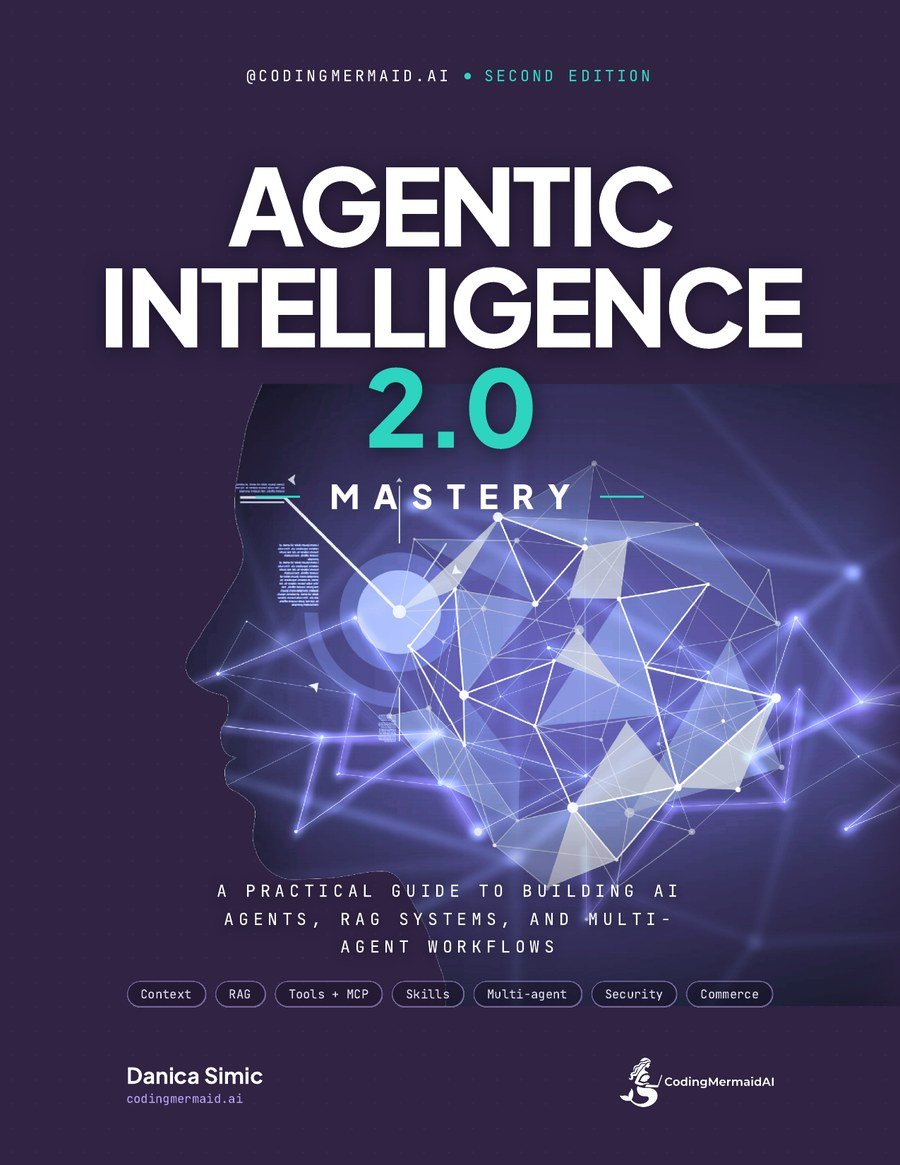
Cover of Agentic Intelligence 2.0 Mastery by Danica Simic: a practical guide to building AI agents, RAG systems, and multi-agent workflows
10+ years
in data, backend and AI engineering
300K+
followers across platforms
250+
people mentored across different roles
Fortune 500
companies and startups served as a consultant

why this book

A demo is easy. A reliable agent is engineering.

Most tutorials stop when the agent answers one question correctly. Real systems fail in quieter ways. They retrieve the wrong document, repeat a tool call, lose a fact during a handoff, or follow an instruction hidden in a web page.

This book teaches the parts around the model that prevent those failures: the harness, the context, the tools, the stopping rules, the checks and the evals. Every idea is explained in plain English first, then built and tested in code.

after reading, you will be able to

01

Design an agent system

Decide when a task needs an agent and when a fixed workflow is better, then sketch the harness, tools and trust boundaries.

02

Engineer the context

Choose what the model sees at each decision, within a budget, so it has the evidence it needs and nothing that misleads it.

03

Build grounded retrieval

Parse, chunk, search, rerank and cite, then turn the pipeline into agentic RAG that knows when to stop or abstain.

04

Connect real tools

Write tool contracts, MCP servers and Agent Skills that an agent can use reliably, with retries and idempotency.

05

Coordinate several agents

Delegate, hand off and share state with a graph coordinator, and measure whether the team beats one agent.

06

Secure and deploy

Threat-model the system, defend against prompt injection, measure guardrails with evals, ship it to the web, and design agents that can pay safely.

what's inside

Three parts. Seventeen chapters. One system you can deploy.

Each part builds on the one before it, so you always know why a new idea is needed.

PART I · p.5

Foundations of agentic systems

00
Modern AI foundations Tokens, embeddings, attention, sampling, prompting and verification.
01
Anatomy of an agent system Agents vs workflows, the harness, tools, memory and the execution loop.
02
Context engineering Budgets, structured evidence, memory and handoffs. Lab: a context assembler.
PART II · p.86

Retrieval and agentic RAG

03
RAG foundations Parsing, OCR, chunking, embeddings, indexes and a tested ingestion pipeline.
04
Retrieval engineering Hybrid search, query rewriting, reranking, citations and retrieval metrics.
05
Agentic RAG Routing, decomposition, corrective search and precise abstention.
06
Project: Clinical guidelines RAG assistant Hybrid search, reranking, citation checks and evaluation.
PART III · p.143

Tools, MCP, skills and orchestration

07
Tool engineering and connectors Contracts, pagination, retries, idempotency and useful errors.
08
Model Context Protocol in practice Hosts, clients and servers, and a hands-on jobs server.
09
Agent Skills and reusable procedures SKILL.md, progressive loading and a validated skill for Claude.
10
Agent loops and harness engineering Stopping rules, budgets, checkpoints, recovery and verification.
11
Graph engineering Nodes, state, routing, reducers and approval with LangGraph.
12
Project: Weekly planning agent Model for language, code for time, with safe writes and replanning.
13
Multi-agent architecture Delegation, handoffs, shared state and a small coordinator.
14
Project: Multi-agent job application system Six agents, cited drafts and a two-layer review.
15
Secure, reliable and ready to deploy Threat models, guardrails, evals and serverless deployment.
16
Agents that pay: agentic commerce Commerce protocols, signed mandates and rules for agents that spend.

in every chapter

Explained, drawn, then tested.

Chapters follow the same rhythm. A real request opens the chapter, a diagram shows the moving parts, and a hands-on exercise ends with a check you can run.

Diagrams
Comparison tables
Prompt templates
Code you can copy
Case studies
Tick-off checklists
Worksheets
Quiz and summary
chapter_10.md · Types of agentic loops
Bounded tool use
model turns3 / 4
tool calls2 / 4
elapsed seconds22 / 60
prompt · communicates intent
"Please use no more than four turns"
code · enforces the limit
if turns >= 4: stop

A bound is an execution rule, not a suggestion in a prompt.

build along

Three real projects, each with its own repository.

Clone the code at the exact version the chapter uses, run the tests, and extend it. Nothing is hidden behind a screenshot.

Chapter 06

Clinical guidelines RAG assistant

A local app that answers questions from clinical guidelines with hybrid search, reranking and citation checks, then measures itself with an evaluation set.

hybrid search reranking citations evals
github.com/codingmermaid/clinical-guidelines-rag
Chapter 12

Weekly planning agent

An agent that turns a request into tasks, schedules them with plain code, validates every plan and asks for approval before it writes anything.

LangGraph interrupts validation
github.com/codingmermaid/weekly-planning-agent
Chapters 14 and 15

Multi-agent job application system

Six agents research jobs, write cited drafts and pass a two-layer review. Then you secure it against prompt injection and deploy it to the web.

6 agents guardrails Postgres serverless
github.com/codingmermaid/job-application-agent

is it for you

Written for builders who want to understand.

This book is for you if

You can read basic Python and want to build agents, not only use them.
You have tried agent tutorials and want to understand why they break.
You are a data scientist, analyst or developer moving into AI engineering.
You prefer clear explanations and tested code over hype.

It may not suit you if

You want a no-code tool walkthrough with no programming at all.
You are looking for research on training new language models.
You want quick prompt tricks rather than an engineering method.

about the author

Hi, I'm Danica Simic.

I am a data scientist and AI consultant with more than ten years in tech, from technical writing and database administration to backend development and AI engineering. I hold a Master's in Data Science and founded Aurora Data Strategies, a data and AI consultancy.

I have taught machine learning since 2023 and mentored more than 250 people across different roles. Across my platforms, I explain AI in plain English to more than 300,000 people. This book is how I would teach agents to you in person: slowly, clearly, and with code that runs.

Instagram LinkedIn GitHub

get the book

Start building this week.

ebook
$47
The full 447-page PDF, 17 chapters
Code from three public project repositories
Prompt templates, checklists and worksheets
Quizzes and summaries for every chapter
Buy now on Stan · $47

Secure checkout on Stan · Instant PDF download

questions

Frequently asked

How much programming do I need?

Basic familiarity with Python helps. Every concept is explained in plain English before the code, and the first chapter needs only a chat interface.

Which models and tools does it use?

The ideas work with any model provider. The hands-on chapters use Claude and ChatGPT, MCP, Agent Skills, LangGraph and Python, and the projects can run on free tiers.

What format is the book?

A 447-page PDF you can read on any device. The code lives in public GitHub repositories, pinned to the exact version each chapter uses.

From your first loop to a deployed multi-agent system.

One book, three repositories, and a method you can reuse on every agent you build after it.

Get Agentic Intelligence Mastery 2.0
Agentic Intelligence 2.0PDF · 447 pages
Buy · $47